
How to Check a Locksmith Before Work Begins
A legitimate locksmith gives you a real business name, quotes a price range before driving out, and tries non-destructive entry before drilling anything. That is most of how to tell if a locksmith is legitimate. Most locksmith scams in Toronto and the GTA fail at least one of those three tests during the first phone call. So start checking on the phone, before anyone is on their way.
Real dispatcher answersOpen every day, 7 AM to 10:30 PM
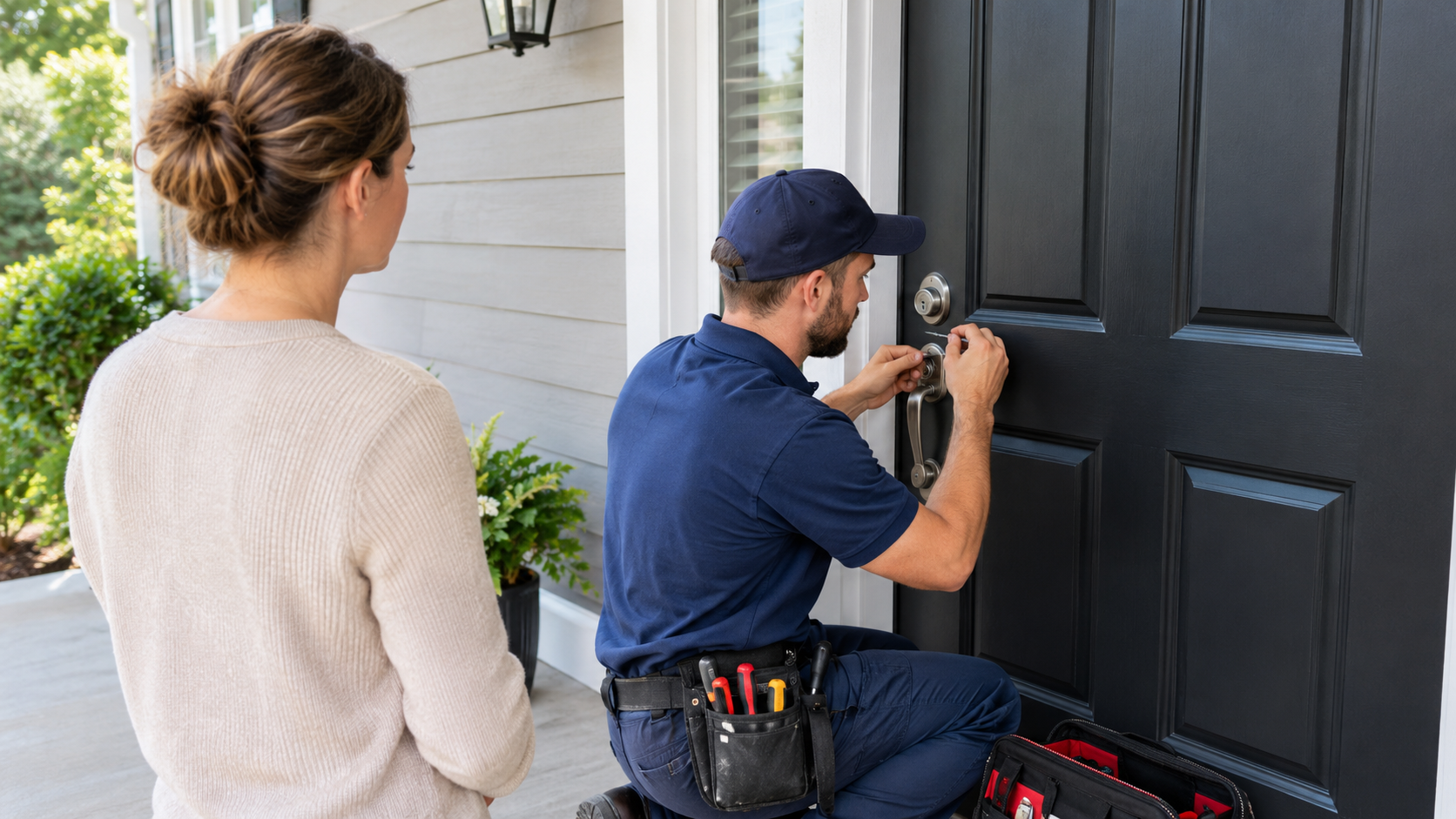
How do you tell if a locksmith is legitimate?
Work through these checks in order. Most take only a moment, and you can do the first three while you wait outside or sit in a warm car.
1. Look past the ad to the business behind it
Search the company name with the word "reviews." Look for a consistent name, website, and service area. A listing with only a phone number and a generic name like "Locksmith Toronto" is often a call centre. It sells your job to whoever is nearby.
2. Ask who you are calling
If someone answers with "locksmith service" and no company name, ask for the name and write it down. A legitimate business says its name without hesitating.
3. Ask for a price range for your exact job
Describe the door, the lock, and what happened. Then ask what the service call costs, what the labour range is, and what would push the price up.
4. Match the name
The vehicle, uniform, ID card, or invoice should carry the business name you were given on the phone. If none of them do, ask why before any work starts.
5. Expect to be asked for ID
A legitimate locksmith asks for proof of ownership or authorization before opening a home, car, or storefront. A locksmith who opens your door without asking will open someone else's too.
6. Ask which method they will try first
For most residential lockouts, the answer should be non-destructive entry. That means picking or bypassing the lock without damaging it.
7. Get the new price before the work changes
If the price goes up, ask for the new figure and the reason before they continue. Do not let a job move forward on a vague "it'll be a bit more."
8. Get an itemized invoice
It should show the business name, contact details, the work done, parts, and tax. Pay by card when you can, because a card payment is easier to dispute than cash.
Before you call
When the technician arrives
Before you pay
Why search results are full of fake locksmiths
Many locksmith listings are built to catch emergency searches. A listing may use a made-up address, a name stuffed with search keywords, and a phone number that rings a call centre outside the city. That call centre quotes a low figure. Then it sends a subcontractor who sets the real price at your door.
A few signs give these listings away:
A paid ad at the top of the results proves only that someone paid for the ad. It says nothing about who will show up.
- The map pin lands on a parking lot, a strip of empty road, or a private house.
- Several listings with different names share the same phone number.
- The business name is only a phrase, such as "Emergency Locksmith Near Me."
- The website lists dozens of cities and no actual street presence in any of them.
Quotes that change at the door
Price is where most bad experiences happen. An honest locksmith may not know the final cost until they see the lock. However, they can still give you a range and tell you what changes it. A caller who refuses any range at all is protecting their own margin, not managing your expectations.
If the on-site quote is far above the phone range, ask why. If the technician can't explain it, you can decline before work starts. You owe a fair service call for the visit. You do not owe a price you never agreed to.
| What you hear | What it often means | What to do |
|---|---|---|
| "Low service fee" with no labour figure | The fee covers only the drive | Ask for the total range for your job |
| "We'll know when we get there" and nothing else | The price is open-ended on purpose | Describe the lock and ask for low and high cases |
| "This is high-security, it has to be drilled" | A setup to sell a new lock | Ask for the brand and a picking attempt first |
| A new, higher price after the door is open | Bait-and-switch | Ask for the reason in writing and do not sign |
| "Cash only" | No paper trail | Ask about card payment or stop the job |
When drilling is the first move
Drilling destroys the lock cylinder. The locksmith then has to sell you a replacement, so drilling first adds new hardware to the labour charge. On a standard residential deadbolt, picking or bypassing should come first in most cases.
Some situations do call for drilling. Examples include a broken key jammed deep in the keyway, a failed internal part, or a high-security cylinder built to resist picking. Ask the technician to explain what they tried and why it failed. Our guide on when emergency lock drilling is truly justified walks through those cases in more detail.
Keep the drilled cylinder after the job. If you later question the work, another technician can look at it and tell you whether drilling was needed.
What licences and associations actually prove
Licensing rules depend on where you live. California is one place with a strict state system. Under rules set by the California Bureau of Security and Investigative Services, locksmith licence applicants must be at least 18 years old. They must also provide the required documents and pass background checks through the state Department of Justice (DOJ) and the Federal Bureau of Investigation (FBI).
Ontario does not issue an equivalent provincial locksmith licence. As a result, a caller who quotes a "licence number" may be pointing to a business registration or nothing at all. Ask what the number is and who issued it.
Two checks matter more here than any claimed licence:
You can run these same checks on us. Our background and service area are on the About Toronto Premier Locksmith page.
- Trade association membership. Confirm it with the association directly. A logo on a van or a website costs nothing to copy.
- Liability insurance. Ask whether the business carries it. Condo boards and commercial landlords often require a certificate of insurance before a technician can touch building hardware.
Condos, rentals, and cars add their own checks
In a Toronto condo, a legitimate locksmith expects to sign in with the concierge and may need elevator or parkade access. They will not ask you to sneak them past the front desk. If a technician pushes to skip building rules, that tells you how they treat other rules too. For safe steps while you wait in a building lobby or outside after dark, see what to do if you're locked out at night.
Rentals add an authorization question. A tenant can usually request entry to their own unit. Rekeying or replacing the hardware, however, may need the landlord's or property manager's approval under the lease. A careful locksmith asks who approves the change before starting.
Cars need vehicle information. Have the vehicle identification number (VIN), the year, make, and model, and registration or other proof that you can authorize the work. Many modern keys hold a transponder, a small chip that must be paired with the car's immobilizer before the engine will start. If someone offers to cut and program a key without asking for any proof, walk away. That same shortcut is how stolen cars get started.
What to do if you think you were scammed
Act quickly while the details are fresh. Use this checklist:
A factual complaint with an invoice behind it carries far more weight than an angry review with no details. It also helps the next person searching at midnight.
- Keep the invoice, receipts, and any text messages or call logs.
- Photograph the door, the lock, and any damage.
- Keep the removed or drilled cylinder.
- Call your card issuer to dispute the charge if the price was never agreed.
- Report fraud to the Canadian Anti-Fraud Centre.
- File a complaint with Ontario's consumer protection office, and leave a factual review that names the business on the invoice.
FAQ
Common questions
Quick answers about this topic in Toronto and the GTA.
Is an unmarked vehicle always a sign of a fake locksmith?
No. Some small owner-operators drive a personal car or van. What matters is whether their ID and the invoice carry the business name you called. If nothing they hand you matches that name, treat it as a warning.
Should I pay a deposit over the phone before anyone shows up?
Avoid it for a lockout. You have no way to confirm who will arrive or what they will charge. Special-order hardware, such as a commercial lock or a specific smart lock, can be an exception. In that case, a deposit is reasonable once you have a written quote from a business you've checked.
The locksmith won't open my door because I can't prove I live here. Is that a bad sign?
It's a good sign. Offer whatever you have: photo ID with your address, a lease, mail inside the unit, or a call to the concierge or landlord. A technician who holds that line is also protecting your home from strangers.
Can I ask to watch the work being done?
Yes. A legitimate technician has no reason to hide how they open a lock or swap a cylinder. Stay at a safe distance so you're not in the way of tools. Ask questions before they start rather than during the job.
More reading
Related guides
More step-by-step and how-to articles on the same topic.
How to Vet a Mobile Locksmith Before They Arrive
A safe locksmith call starts before arrival. Check identity, licensing, insurance, written pricing, entry methods, equipment, and proof of ownership.
Read article Locksmith guidesLocked Out at Night? Safe Steps Before Calling a Locksmith
Stay safe during a nighttime lockout with practical steps for checking authorized entry, spotting emergencies, and calling a qualified locksmith.
Read article Locksmith guidesToronto Condo Lockout Costs: Fees to Check First
A Toronto condo lockout often runs $70 to $220 before extras. See how after-hours fees, concierge rules, taxes, and repairs can change the final bill.
Read articleReady for upfront pricing?
Describe your door or vehicle for a quoted range before a technician is dispatched.