
Key Fob Troubleshooting: Battery, Signal or Car?
Start with the battery. When a key fob will not work, a dead or badly seated coin cell is the cause more often than anything else, and it costs a few dollars to rule out. Test your spare fob next, then try the hidden mechanical key on the door. If the buttons still do nothing, the car does not recognize the fob, or the engine will not start with the fob held at the backup location, you are looking at a damaged fob, lost programming, or a vehicle-side fault that needs diagnostic equipment and proof you can authorize the work.
Real dispatcher answersOpen every day, 7 AM to 10:30 PM
What should you check first when a key fob will not work?
Work in this order. It separates a simple workaround from a real fault in a few minutes.
If the doors can be opened by hand but the engine will not turn over with the fob inside, the immobilizer or the fob's transponder is involved. That is a different problem from a remote that stopped clicking.
1. Try the spare fob
If the spare works, the problem is the first fob.
2. Check the vehicle battery
Dim dome lights, a slow crank, or no interior lights at all point at the car, not the remote.
3. Move away from the building
Step out of the parkade, away from your phone, and try again.
4. Note what fails
Buttons only, starting only, or both. That single detail changes the diagnosis.
5. Use the physical key on the driver's door and see if the car
Use the physical key on the driver's door and see if the car powers up normally.
Common reasons a fob stops responding
Most failures fall into a short list. Dead coin cell is first. A battery installed upside down, or one that is the right size but a weak off-brand, comes second. Bent or corroded contacts inside the case cut power even with a fresh cell.
Then there is physical damage: a cracked board, a broken solder joint at the battery clip, or water that got in and left residue behind. Buttons wear out from years of thumb pressure. Programming can also be lost after a dead vehicle battery, a module replacement, or a botched aftermarket install.
Vehicle-side faults are the ones people miss. A failed receiver, a damaged antenna line, a blown fuse for the body control module, or a weak car battery will all make a perfectly good fob look dead.
How do you replace a key fob battery correctly?
Open the case at the seam, not through it. Most fobs have a notch for a small flat screwdriver or a coin. Some have a screw hidden under the emergency key slot. Pry gently and evenly. Cracked plastic is the most common self-inflicted damage on this job.
If a new battery gives you nothing, do not keep swapping cells. Something else is wrong.
- Note which way the old cell sits before you lift it out. Take a photo.
- Match the exact number stamped on the cell (CR2032, CR2025 and similar are not interchangeable in thickness).
- Handle the new cell by the edges. Skin oil on the flat faces adds resistance.
- Seat it fully under the retaining clip, then close the case until it clicks all the way around.
- Test every button, and test the start function too, not just locking and releasing.
Checking polarity, contacts and corrosion
Reversed polarity is the quiet failure. The positive face of a coin cell is the wide flat side with the printing. It usually faces up toward the case, but not always. Get it backwards and the fob is simply dead with a brand-new battery in it.
Look at the metal contacts. They should press firmly against the cell. If a terminal is flattened from an old battery, lift it slightly with a plastic pick, never a metal tool against the board. Green or white powder means a battery leaked. Clean that residue with isopropyl alcohol and a cotton swab before the fob will hold a connection.
Grit and lint also collect under the cell in fobs carried loose in a bag. Wipe the seat clean.
Can the emergency key be used to open or start the vehicle?
Yes, on nearly every modern fob. Look for a small slider, button, or latch on the fob body. Press it and the metal blade pulls straight out. That blade fits the driver's door lock, which may be hidden behind a small plastic cap you pop off with the tip of the key.
Expect the alarm to sound when you open the door this way on a car with a dead fob. Get in, put the fob at the backup start location, and the alarm usually clears once the car recognizes it.
Push-button cars have a passive backup: hold the fob against the start button, against a marked spot on the steering column, or in a slot in the console or armrest. Your owner's manual names the exact spot for your model. That backup uses a low-power coil that reads the transponder) chip directly, so it works with a flat fob battery.
What should you do if the key fob works only intermittently?
Treat intermittent operation as a warning, not a quirk. A fob that works up close but not across a parking lot has a weak cell or a poor contact. One that works only when you squeeze the case has a cracked solder joint or a broken battery clip.
Water damage produces the same pattern: fine one day, unresponsive the next, then fine again after it dries. Corrosion spreads under the board where you cannot see it.
Here is the practical line. If the fob is your only key, replace it rather than nursing it. An intermittent fob strands you eventually, and it always happens somewhere inconvenient. Getting a spare cut and programmed on a working car is far simpler than an all-keys-lost job in a parkade.
Could signal interference be stopping the fob?
Test somewhere else before you condemn the fob. Underground parkades, concrete stairwells, and steel-framed loading docks all swallow the short-range signal fobs use. Downtown Toronto has plenty of spots where nothing gets through until you roll the car forward a little.
Common local sources of interference:
Hold the fob against your chin and press the button. That sounds like a trick, but the head does carry the signal further, and it is a useful field test of whether range is the problem.
| Source | What you see | Quick test |
|---|---|---|
| Parkade or steel structure | Works outside, not inside | Try at street level |
| Phone or wireless earbuds in same pocket | Range drops badly | Move fob to other hand |
| Nearby transmitter or radio tower | Works only close to car | Test in a different neighbourhood |
| Metal keyring bundle or wallet | Weak, inconsistent range | Hold fob alone, arm extended |
Dropped or water-exposed fobs
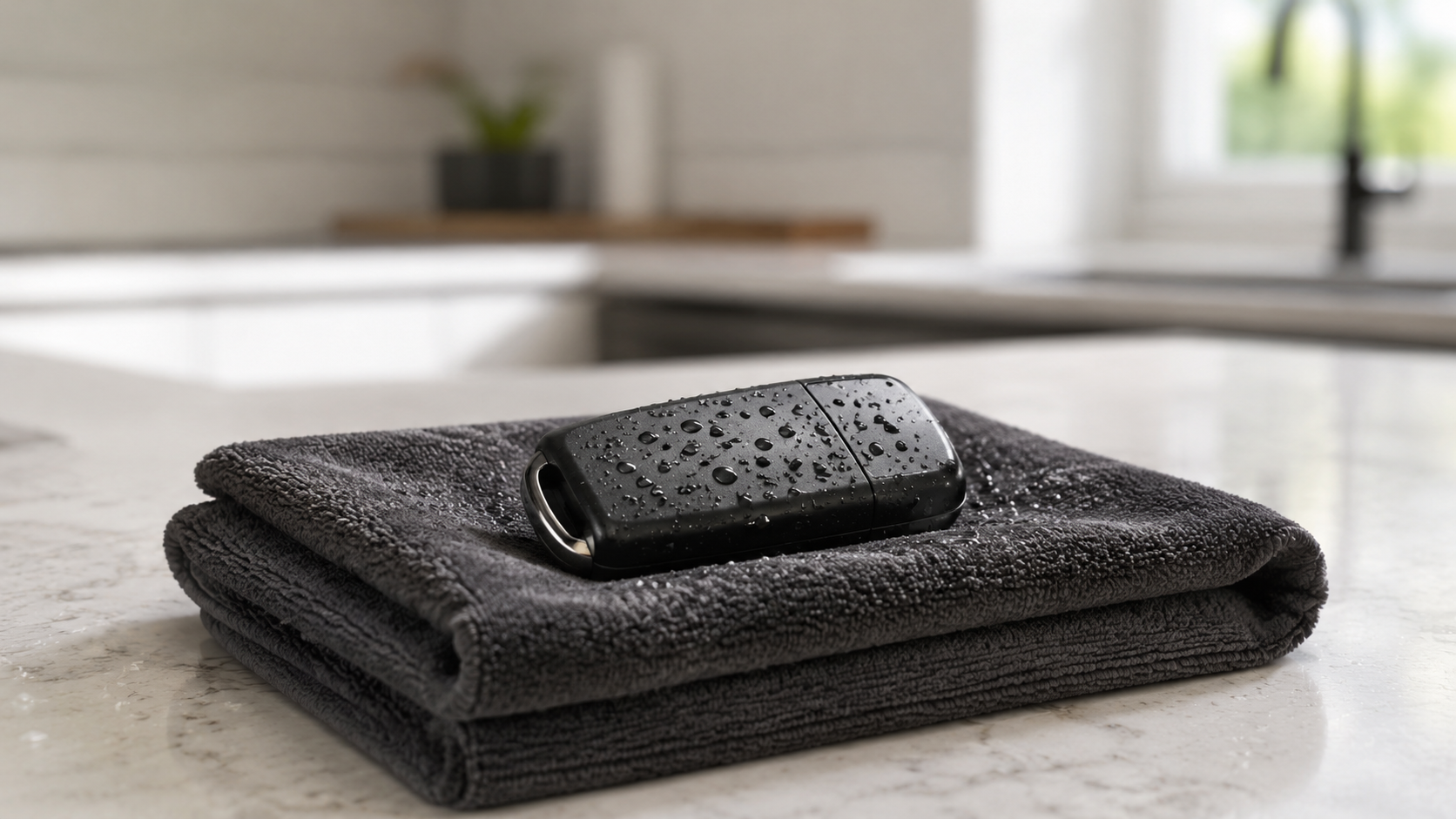
Pull the battery immediately. Leaving a cell in a wet fob drives corrosion across the board quickly. Open the case, remove the battery, and let it dry in open air.
Do not use a hairdryer, oven, or radiator. Heat warps the case, lifts adhesive, and can damage the chip. Do not repeatedly press buttons while it is damp either. You are pushing current through wet contacts.
Once it is dry, inspect the board with a bright light. Water lines, dull residue, or a cracked case mean the fob needs replacement rather than another try. A hard drop onto concrete often shears the battery clip or cracks the antenna trace, and neither is visible until you look closely.
Resetting versus real reprogramming
These are two different jobs, and shops blur the line constantly. Resynchronization is a vehicle-specific sequence, often key cycles or door-lock cycles, that re-pairs a remote the car already knows. It works on some older models and does nothing on most modern ones.
True programming writes the fob's identity into the vehicle's immobilizer. Many cars need a working key present, a security PIN pulled from the manufacturer, or a timed security wait before they accept a new fob. Encrypted systems will not accept anything without proper equipment and authorization.
If the internet gives you a "reset trick" for your exact model, try it once. If it fails, stop. Repeated failed attempts can lock the security system for a wait period or, on some vehicles, put a module into a state that needs a scan tool to clear.
Is it the fob or the vehicle?
Use elimination, in this order:
That short check tells a technician more than a photo of the fob ever will. Write down what happened and what did not.
- Spare fob works: first fob is at fault.
- Neither fob works, interior lights are weak: car battery.
- Neither fob works, car starts fine with physical key and battery is healthy: suspect the receiver, antenna, or a fuse.
- Buttons work, engine will not start: transponder or immobilizer, not the remote circuit.
- Doors lock and release from the interior switch but not from either fob: vehicle-side receiver.
When you need a locksmith or dealer
Call for professional service when the fob is physically damaged, when programming has been lost, or when every key is gone. All-keys-lost work needs the vehicle identification number, year, make, model, trim, plate if you have it, and proof that you can authorize the job. Some vehicles need more than one programmed key, some need dealer-level equipment, and a few cannot be done at the roadside at all.
Damaged circuit boards are not worth repairing on a modern encrypted fob. The chip has to be paired to the car regardless, so replacement plus programming is the honest path. A mobile automotive locksmith in Toronto and the GTA can handle most cut-and-program work at the vehicle, and car key replacement at your doorstep covers the common cases where the car is drivable but keyless.
A couple of GTA realities are worth planning around. Underground parkades often have no cell signal and restricted contractor access, so arrange concierge or building approval before anyone arrives. If the car sits on a low-ceiling parkade level, most programming equipment still works fine, but towing to dealer service becomes a much bigger problem if the vehicle turns out to need it.
Related: Call Toronto Locksmith for Quote & ETA
FAQ
Common questions
Quick answers about this topic in Toronto and the GTA.
Will a dead key fob battery stop the car from starting?
Usually not, on push-button vehicles. The backup coil reads the chip when you hold the fob at the marked spot, so the car starts even with a flat cell. On older systems with a bladed key, the fob battery only powers the remote buttons and has nothing to do with starting.
Can a cold Toronto winter kill a fob battery early?
Yes. Coin cells lose voltage in the cold, and a cell that was already marginal in the fall often quits on the first hard freeze. If your range drops in winter and recovers indoors, replace the battery before it fails outright.
Does disconnecting the car battery erase fob programming?
On most vehicles, no. Programming lives in the immobilizer module and survives a battery disconnect. A few models drop the remote-lock pairing and need a short resynchronization afterward, which the owner's manual describes.
Can I buy a fob online and program it myself?
Sometimes, on older or simpler vehicles. Aftermarket fobs vary widely in quality, and some cannot be programmed at all because the chip type does not match. Confirm the exact part number and the programming requirement for your vehicle before buying anything.
How many working keys should I keep?
Keep a spare, stored somewhere other than your main keyring. Programming an extra key while your current one still works is straightforward. Once every key is gone, the job gets longer, needs more documentation, and on some vehicles requires dealer service.
Ready for upfront pricing?
Describe your door or vehicle for a quoted range before a technician is dispatched.