
Locked Out of Your Toronto Office? Start Here
Start by securing people, confirming who can authorize entry, and identifying the failure before anyone touches the door. An office lockout in Toronto usually comes down to a lost key, a failed lock cylinder, a misaligned latch, a dead keypad battery, an invalid fob, or a building access outage. If approved entry cannot be restored without damage, call a qualified commercial locksmith. Do not force the door or bypass workplace safety controls.
Real dispatcher answersOpen every day, 7 AM to 10:30 PM

In this guide
Storefront and office lockouts during open hours
What should you do first during an office lockout in Toronto?
Keep staff away from the door until you know the failure mode. A jammed latch can release suddenly. A damaged glass or aluminum frame can become a safety hazard.
Follow this order:
Do not push a second key into a tight keyway. Do not pry the frame, drill the cylinder, or disconnect an access-control device because the office is late opening. Those actions can turn a simple key problem into a door, frame, alarm, or insurance problem.
If there is an active break-in or immediate danger, call 911, Ontario's emergency telephone number. Do not treat a fresh crime scene as an ordinary office lockout.
1. Confirm authorization
Identify the business owner, office manager, property manager, or person authorized to approve entry.
2. Check approved entrances
Try the main entrance, loading entrance, rear door, and any building-approved access point.
3. Contact building management
In a condo-style office tower, the concierge or property manager may control elevator access, after-hours entry, and electric locks.
4. Protect staff and visitors
Move people away from the doorway, especially if glass, a panic bar, or damaged hardware is involved.
5. Check the access system
Ask whether other tenants or doors are also affected. A wider outage points to the building system, not your office lock.
6. Document the condition
Photograph the lock, frame, strike, keypad, reader, and visible damage before repair work starts.
7. Call for commercial service
Give the technician the door type, suite number, hardware type, and exact symptom.
When emergency service is the right call
Call for 24-hour commercial service when the office cannot be entered through an approved route and the next safe check would require force, disassembly, or access-system work. You also need emergency help after a break-in, a failed panic bar, a damaged lock cylinder, or a door that will not release during business hours.
Confirm the service scope, arrival estimate, and price range before dispatch. A vague quote over the phone often changes once the technician sees the door.
Give the dispatcher:
A commercial technician brings extraction tools, key-cutting equipment, replacement cylinders, panic-bar parts, and access-control knowledge suited to the door. An improvised tool may push a broken key deeper. It may also damage the pins, latch, frame, or wiring.
For the broader service scope, see the commercial locksmith service in Toronto and the GTA. The right call starts with an accurate description, not a guess about the replacement part.
- The full address and suite number
- The door material, such as glass aluminum, wood, or steel
- The lock type, such as a rim cylinder, mortise lock, keypad, fob reader, electric strike, or panic bar
- The exact symptom
- The number of doors affected
- Any concierge, loading-dock, elevator, or sign-in rules
- The name of the person meeting the technician
- Whether police, building management, or insurance has documented damage
How can a business locksmith identify the actual failure?
A business locksmith should check the key, cylinder, latch, door, frame, strike, credential, and building system before replacing anything. The visible lock is often not the failed part.
A lost key creates an authorization and security problem. A damaged key creates a mechanical problem. A failed fob may have nothing to do with the lock itself.
The technician should also ask who last entered and which doors are affected. It helps to know whether the failure began after a power interruption, and whether the door has been dragging. Those details narrow the fault before parts come off.
| Symptom | Likely failure | Safe first check |
|---|---|---|
| Key will not enter or turn | Wrong key, damaged key, worn cylinder, or debris | Check the key profile and inspect the keyway |
| Key turns but the latch stays in place | Broken tailpiece, disconnected latch, or internal lock failure | Apply light door pressure while turning once |
| Door opens from inside but not outside | Exterior cylinder, trim, or access reader problem | Check whether the inside release works |
| Door drags against the frame | Strike alignment, hinges, closer, or shifted frame | Test the door with no key pressure |
| Keypad accepts no code | Dead battery, wrong code, lockout mode, or controller fault | Check the keypad response and battery status |
| Fob fails at one door | Credential issue, reader fault, or power problem | Test an approved fob at another door |
| Several doors fail together | Building power, controller, network, or access-system outage | Contact property management |
| Panic bar will not release | Jammed latch, damaged exit device, pressure, or fire-door issue | Keep people clear and stop forcing the bar |
Troubleshooting without making it worse
Start with checks that do not alter the lock. Stop as soon as the door, key, reader, or frame shows signs of damage.
Mechanical doors
A door that opens when you relieve pressure has a strike-alignment problem until proven otherwise. A strike is the metal plate that receives the latch. Tight weather seals, sagging hinges, a failing door closer, or a shifted frame can hold the latch against it.
Do not spray general household oil into the keyway. Do not hammer the key, turn it with pliers, or insert another object behind a broken fragment. If the fragment moves deeper or the cylinder is turned, stop and arrange extraction.
- Try the correct key once without twisting hard.
- Check whether the key is bent, cracked, or badly worn.
- Push or pull the door lightly while turning the key.
- Watch whether the latch retracts.
- Check for loose strike screws or a visibly shifted frame.
- Test the door from the inside only if you can enter safely.
- Listen for a broken spring, grinding cylinder, or loose hardware.
Keypads and fob readers
A dead battery may leave a keypad dark. A denied credential may show normal lights but still refuse entry. A whole-building failure needs the access-control administrator or property manager, not repeated attempts with the same fob.
- Check whether the keypad lights or beeps.
- Confirm that the code is approved and current.
- Check the battery compartment if it is accessible without removing the lock.
- Present the fob squarely to the reader.
- Test an authorized credential at another controlled door.
- Ask building management whether access control is offline.
- Do not unplug a controller or defeat a reader to enter.
Electric strikes and powered doors
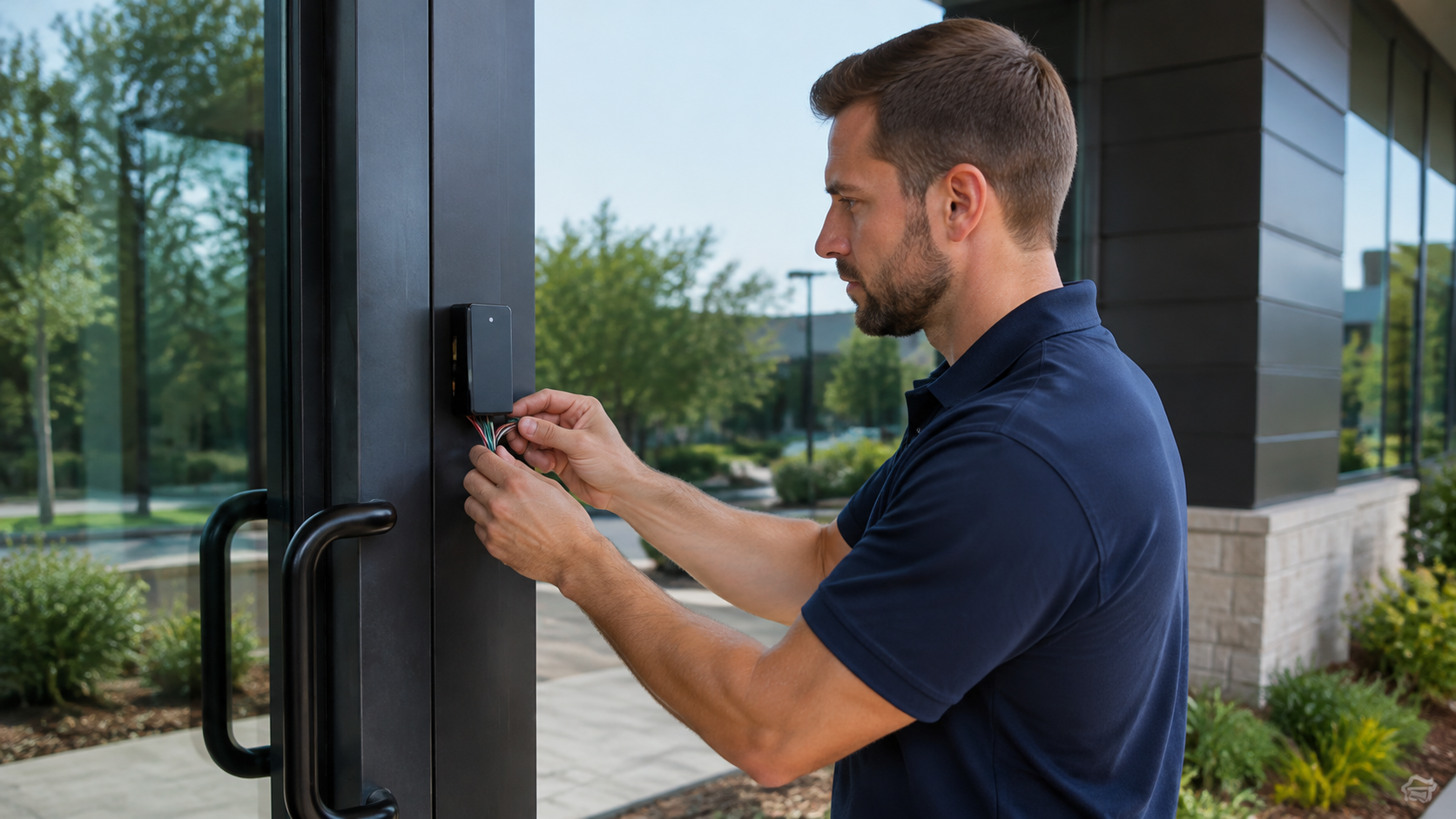
An electric strike is the door-frame device that releases the latch after an approved signal. Check whether nearby readers, exit buttons, and doors have power. Do not open panels or handle wiring unless you are trained and authorized to do so.
The failure may be in the power supply, controller, wiring, reader, strike, or software permission. A locksmith can inspect the mechanical side. Dealer-level programming or building-system support may still be required.
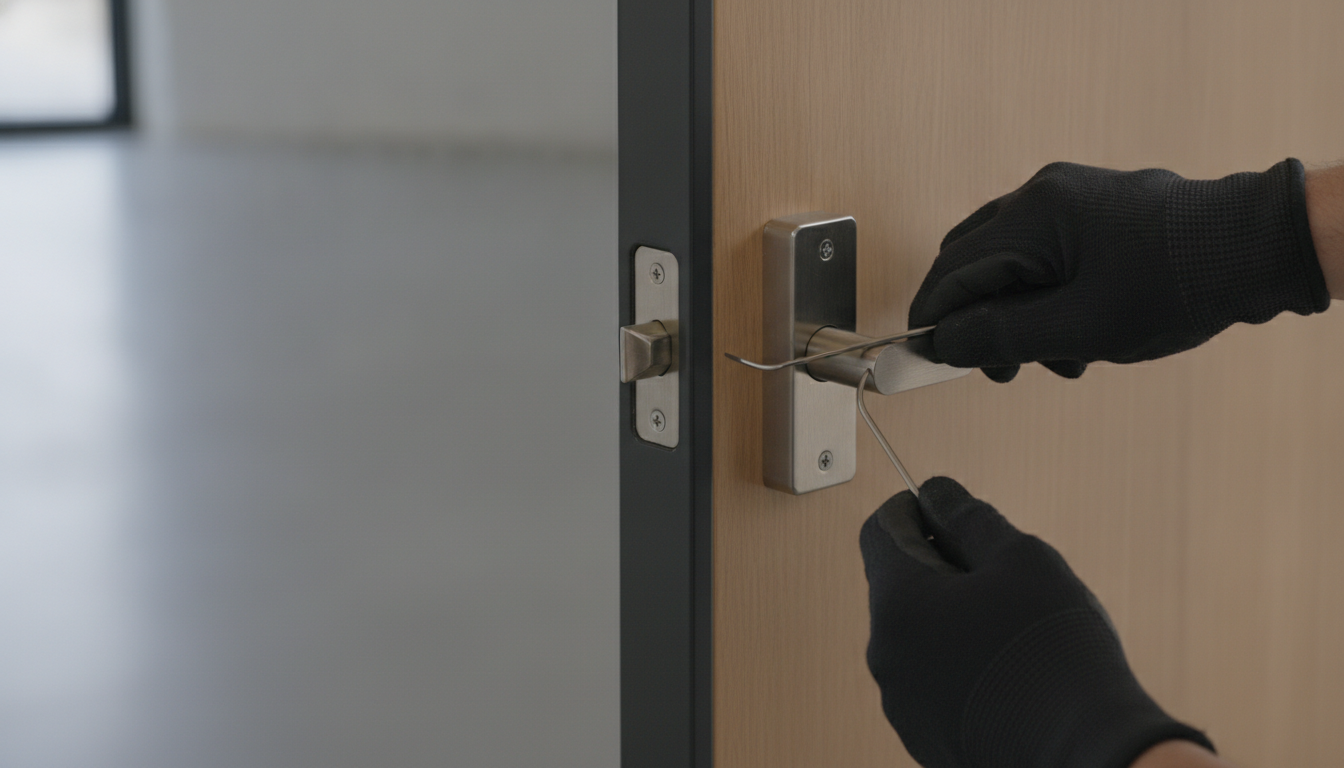
Repair, replacement, or rekey
Repair the office lock when the cylinder is worn but the latch, housing, screws, door, and strike remain sound. Repair may include adjusting the strike, replacing a small internal part, tightening hardware, correcting the door prep, or servicing a panic bar.
Replace the hardware when the housing is bent, the latch is damaged, the cylinder has been attacked, or the lock lacks a needed security feature. Replace more than the visible cylinder if the frame, strike, hinges, closer, or lock body caused the problem.
Rekey the lock when the hardware is in good condition but old keys should stop working. A locksmith changes the pins inside the lock cylinder so a new key operates it. The lock body and exterior hardware stay in place.
Rekeying is useful after:
For a leased office, condo office, or managed commercial building, confirm authorization first. The landlord or property manager may control the cylinder format, master-key system, door closer, panic bar, fire-door hardware, and access software.
A new cylinder that does not fit the existing master-key system can create another lockout. Match the replacement to the door prep and key hierarchy before ordering parts.
- A staff member leaves with a key
- A key is lost or copied without control
- A contractor's access ends
- A master-key level changes
- A tenant takes over an office
- A break-in exposes a cylinder
How do electronic locks change the lockout response?
Electronic access changes the first question. You need to know whether the credential is invalid, the reader is offline, the lock has no power, or the building system has denied the door.
A credential is the approved code, fob, card, or mobile permission used to request entry. Check its status through the access administrator. A locksmith cannot always restore permissions that were revoked in software.
Electronic locks also differ in how they fail:
Check the manufacturer's approved override procedure and the building's emergency plan. Do not short wires, remove covers, clone a credential, or hold a door open with an unauthorized object.
Audit logs can show which credential was presented and whether the system denied or accepted it. Preserve those records after a dispute, suspected misuse, or employee departure.
A labor dispute or staff lockout also needs management and legal direction. A locksmith should not decide who is entitled to enter. Dealer-level support may be required for proprietary software, encrypted credentials, controller replacement, or administrator recovery. Plan for that before promising staff that a mobile visit will restore every function.
- Fail-secure locks stay locked when power is lost. People may remain outside until power or an approved override is restored.
- Fail-safe locks release when power is lost. This affects security and emergency planning.
- Battery-powered locks may stop responding when the battery is depleted.
- Networked readers may work locally but fail to confirm permissions if the controller or network is down.
- Electric strikes may have a mechanical latch problem even when the reader beeps normally.
Fixing the process, not just the door
Fix the failure first, then correct the process that allowed it. Buying a smarter reader will not solve missing records, unmanaged keys, or a door that drags in its frame.
Use a written access plan that covers:
Keep the backup method separate from the main failure. If every manager relies on the same fob system, a controller outage can stop the whole office. A physical key, approved override, or building-managed entry plan may be necessary.
Do not leave a master key in an unmarked desk drawer. Do not issue broad access because it is easier to manage. Master-key records should show who can open which doors and who can authorize a change.
For related maintenance and security guidance, the locksmith tips and guides provide a useful starting point. The access plan still needs to match your lease, building rules, insurance requirements, and actual door hardware.
- A controlled key and credential inventory
- Named administrators for electronic access
- A record of master-key levels
- Immediate credential revocation after staff changes
- Spare-key custody with restricted access
- Door sensors for critical rooms
- Battery replacement and power checks
- A backup entry method
- After-hours contacts for the landlord and building manager
- A record of approved locksmiths and access rules
Lockout/tagout rules during equipment repair
Ordinary office access problems are different from hazardous maintenance. Lockout/tagout is a safety procedure for controlling hazardous energy before authorized workers service equipment.
If a door is simply locked and no hazardous equipment is being serviced, do not call it a lockout/tagout event. If a repair involves an automatic door, powered operator, gate, elevator interface, machine, or compactor, stop and follow the employer's written procedure.
The procedure should identify:
Only trained and authorized workers should apply or remove energy-isolation devices. Staff waiting outside an office should not pull a disconnect or remove another worker's tag.
The Canadian Centre for Occupational Health and Safety lockout guidance explains the basic control process. Your employer's procedure and applicable workplace rules still govern the job.
1. The equipment and energy sources
2. The person authorized to perform the work
3. The shutdown method
4. The isolation points
5. The locks and tags used
6. The verification step
7. The process for removing the controls and returning equipment to service
Energy isolation during equipment maintenance
Identify every energy source before servicing equipment. Electrical power is only one possibility.
The review may include:
A door operator can still move after its switch is turned off. A spring, counterweight, closing device, or stored electrical charge may remain active. So turning off a wall switch is not proof of isolation.
The authorized worker should shut down the equipment, isolate each energy source, and apply the required lock and tag. Then release or restrain stored energy and verify that the equipment cannot operate. Verification must use the employer's approved method.
If the isolation points are unclear, stop the repair. Use a qualified electrician, millwright, door technician, or access-control specialist suited to the equipment. A locksmith can address the lock cylinder or door hardware. That does not make the locksmith the right person for every powered system.
- Electrical energy
- Mechanical movement
- Hydraulic pressure
- Pneumatic pressure
- Thermal energy
- Gravity or suspended parts
- Stored spring force
- Batteries or capacitors
- Pressure trapped in a line
What should you verify before hiring a commercial locksmith?
Verify the locksmith before work begins, especially if the technician will enter a restricted office or handle a master-key system. A low price does not help if the person damages the door or leaves no record of the change.
Use this checklist:
Ask what the technician needs to see before entry. Proof of ownership, a lease, business identification, a property manager's approval, or a named contact may be required.
Ask for the failure diagnosis before approving replacement hardware. A cylinder swap will not correct a loose strike, failed closer, bent frame, dead reader, or building power outage.
The emergency locksmith service in Toronto and the GTA page can help you compare the service scope before calling. Still, confirm the details for your specific office and building.
- Commercial office and storefront experience
- Familiarity with panic bars, electric strikes, mortise locks, and access readers
- Clear authorization checks
- Non-destructive entry as the first approach
- A price range before dispatch
- Confirmation of extra charges or replacement parts
- Proof of insurance when required by the building
- Written records of keys, cylinders, and credentials changed
- A plan for damaged doors or frames
- Respect for concierge, property manager, and sign-in rules
Preventing the next lockout
Prevent the next office lockout by assigning access responsibility and maintaining the hardware before it fails. Most businesses track employees more carefully than they track keys, batteries, and door conditions. That gap causes repeat problems.
Keep these records current:
Train staff to report a stiff key, dragging door, loose strike, slow closer, or intermittent reader. Those are failure warnings, not minor annoyances.
Keep a current photo of each critical door's hardware. Include the lock face, reader, panic bar, closer, strike, and surrounding frame. A photo will not replace an inspection, but it helps a technician bring the right equipment.
Review the plan after staff changes, renovations, a break-in, a power failure, or a change in tenancy. If a former key holder may have copied a key, rekey the exposed cylinders and update the records.
- Every issued key and credential
- The doors each key or credential can open
- Spare-key custody
- Master-key levels
- Credential revocation dates
- Battery changes
- Door and panic-bar inspections
- Building management contacts
- After-hours locksmith contacts
- Approved entry and override methods
How commercial calls differ from residential
Panic bars, electric strikes, and aluminum storefront channels need commercial-grade tools. A house lockout kit is not enough for a Queen Street retail door.
Property managers should share after-hours access, loading dock rules, and whether police already documented a break-in.
Master-key buildings can often rekey one exposed cylinder instead of replacing every lock on the floor.
Documentation that speeds insurance follow-up
Photograph damaged strikes and frames before hardware is removed. List which doors were touched versus only attempted.
We note whether the frame, strike, or cylinder failed so you can send accurate info to adjusters.
Board-up and cylinder replacement can happen same visit when parts are on the van.
FAQ
Common questions
Quick answers about this topic in Toronto and the GTA.
Can a locksmith open an office without damaging the door?
Often, yes, if the lock and door condition allow non-destructive entry. The method depends on the cylinder, latch, panic hardware, frame, and whether an access-control system is involved. A damaged or attacked lock may require replacement after entry.
Can an office locksmith bypass a fob reader?
A locksmith should not bypass an access-control system without authorization. The safer route is to confirm the credential, check the reader and power, and involve the access administrator or building manager. Forced bypass can create a security and audit problem.
Who can approve entry during a Toronto office lockout?
The business owner, authorized manager, tenant representative, landlord, or property manager may approve entry, depending on the lease and building rules. A technician should verify authority before opening a restricted office. Staff presence alone does not prove access rights.
Should you replace every office lock after an employee leaves?
Usually not. If the hardware is sound, rekey the exposed cylinders and revise the access records. Replace the system when keys cannot be controlled, the hardware is compromised, or the existing key structure no longer meets the business's security needs.
What information should you keep for an after-hours office lockout?
Keep the address, suite number, building contact, concierge rules, approved decision-makers, door photos, lock type, and spare-key or credential instructions in a restricted emergency record. Do not store a master key or access code in an openly shared document.
Do you work on panic bars after hours?
We are open daily 7 AM to 10:30 PM, not overnight. Call during those hours for commercial emergencies.
Can you rekey after employee termination same day?
Often yes for exposed cylinders. Share how many doors the former key holder accessed.
More reading
Related guides
More step-by-step and how-to articles on the same topic.
Broken Key & Lock Repair
A key that snapped in the lock or a knob that spins freely is common, and rarely a DIY win if the piece sits flush inside. What usually broke, and what a mobile locksmith does on site.
Read article Home securityHow GTA Homes Avoid Smart Lock Installation Problems
A proper GTA smart lock installation starts with door fit, condo rules, battery planning, and backup access. Use this guide to avoid lockouts.
Read articleOn-site help
Related locksmith services
If you need a technician on site, these service pages match this guide.
Guides explain the situation; a service visit fixes it. For commercial locksmith in Toronto and the GTA, use the call button for a price range and ETA, confirmed on site before work starts.
Commercial Locksmith
Master keys, access control, and commercial-grade locks for your business.
See details
Emergency Locksmith
Locked out or dealing with a broken lock? We come to you fast across the GTA.
See details
Security Solutions
Smart locks, high-security cylinders, and access control for homes and businesses.
See detailsReady for upfront pricing?
Describe your door or vehicle for a quoted range before a technician is dispatched.